Latest posts
Matching LIKE in the FSST Domain
Jul 10, 2026 · by Joe Isaacs and Martin Prammer · 10 min read
This is part one of a two-part series. It introduces how Vortex evaluatesLIKEpredicates directly over FSST-compressed strings. We investigate the performance considerations of our design in part two: Compile or Prefilter?
Vortex, our
open-source columnar format, stores string columns using
FSST,
a lightweight encoding that compresses 2–3x while still letting you decode any
single value without decompressing its neighbors (let alone an entire chunk or
segment of data). We
wrote about FSST
when we open-sourced our
Rust implementation.
Of course, compression is only half the story; we store data so we can query it
later. A big part of Vortex is being able to
filter data without creating a decompressed intermediate.
While we've already talked about how certain encodings expose opportunities for
filtering without decompression, the applied predicates have generally been on
the simple side, such as equality matching. This blog post explores performing a
more complex set of predicates over strings (
LIKE), without decompressing them
into an intermediate, temporary form first.This post walks through the mechanisms we built to achieve this functionality:
an automaton that reads symbol codes instead of bytes, and a SIMD prefilter that
makes it fast. Part two dives much deeper into our technique, compares it
against the current state of the art, and discusses the lessons we learned by
exploring this design space.
Decompress then match
Most query engines treat compressed strings as opaque: load the column,
decompress it, and hand the raw bytes to a matcher. This workflow is the only
option for "heavyweight" codecs such as Zstd, where fully decompressing the data
is the only way to recover the text. A random-access encoding like FSST enables
a better way to interact with the data: because of the structure of the
compressed form, every value is independently readable, enabling search. Our
goal was to use this functionality to push the
LIKE predicate down onto the
compressed data itself and skip the decompress-first path entirely.A finite automaton that reads FSST symbols
FSST builds a table of up to 255 symbols, each a frequent byte sequence one to
eight bytes long, and replaces each occurrence with a single-byte code. Byte 255
is reserved as an escape, so the pair
(255, c) encodes a literal byte c. A
compressed string is a sequence of codes, and decompression is the process of
performing dictionary lookups and concatenating the symbols represented by those
codes.To search for a particular string in the data (e.g.,
google) without
decompression, we need to search over the code-compressed text. Because FSST
provides a dictionary, an obvious solution to facilitate this search is to see
if the search predicate shows up exactly in the dictionary, as is. However, what
if, instead of an exact code, the compressed string was stored using escape
codes (g, o, o, g, l, e)? Further, what if it were stored using a mix of
escape codes and dictionary entries? It could even overlap another code
(go, o, gle.com). In general, a byte-level substring search over codes is both
wrong (a code's numeric value can coincide with a byte of the search string by
accident) and incomplete (the search string can straddle a symbol boundary). To
make the search sound, we lift the whole problem into code space: we treat FSST
symbol codes as the alphabet of a
deterministic finite automaton
(DFA) that accepts exactly the code sequences whose decompression matches the
pattern, then run it directly over the compressed bytes:Rust
// A compressed string is just a slice of FSST symbol codes.
// We match a substring pattern by stepping a DFA over those
// codes; the bytes are never expanded back into text.
fn matches(codes: &[u8], dfa: &SymbolDfa) -> bool {
    let mut state = dfa.start;
    for &code in codes {
        state = dfa.step(state, code); // one table lookup per code
        if dfa.is_accept(state) {
            return true;
        }
    }
    false
}
A DFA is a small machine for exactly this kind of question. DFAs are built from
a fixed set of states, each of which is associated with a table that specifies
the next state for every possible input. Feed a DFA a series of inputs, and it
steps from state to state; if it ever reaches an accepting state, the answer is
yes. Here, the inputs are FSST codes (rather than characters), so matching a
compressed string costs one table lookup per compressed byte, with no
backtracking and no decompression.
Three properties of FSST make it well-suited for DFA-based compute
(existing research):
- It is a greedy encoding, which means that a string is compressed by repeatedly taking the longest symbol that matches at the cursor, so a whole string, parsed from its start, has exactly one encoding.
- No two symbols share the same three-byte prefix, resulting in unique prefixes. This uniqueness bounds the number of ways a pattern's first bytes can be carved into symbols.
- The last byte of the i-th symbol differs from i itself (index-suffix divergence), which keeps code values from masquerading as the text they encode.
A
LIKE pattern typically consists of one or more % wildcards. The patterns
can be classified into three types: prefixes (abc%), suffixes (%abc), and
substrings (%abc%), each of which builds its own automaton. Note that the
shapes are not equally easy. For example, a prefix is anchored at the start of
the string, exactly where greedy encoding makes each row's parse unique: the
automaton only has to accept the handful of code runs that spell out the prefix,
including the case where the row's final matching symbol runs past the prefix's
end. In contrast, a substring floats to any offset, where the same search-string
bytes can be carved into codes more than one way depending on what precedes
them, so its automaton has to accept every such carving rather than just the
string's own greedy encoding. Full patterns are stitched together from those
pieces.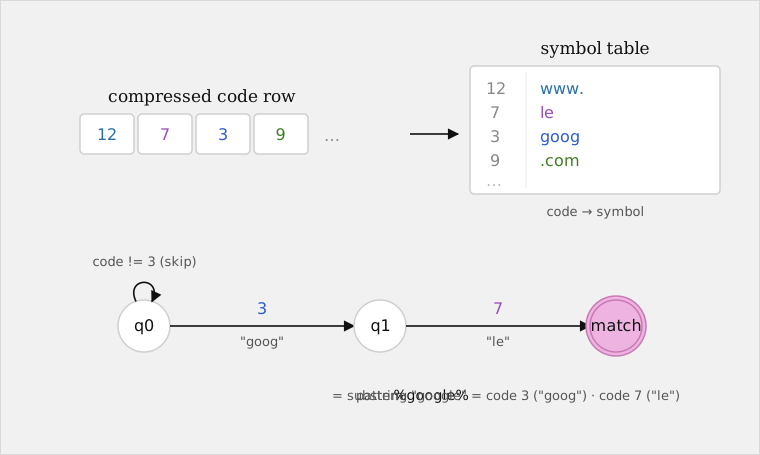
We support the literal pattern shapes that cover the bulk of real
LIKE usage:
prefixes, suffixes, substrings, and ordered multi-segment patterns like %a%b%.
For a supported pattern, the code-space result is designed to be exact:
identical, bit for bit, to running LIKE on the decompressed text, and we
validate every measurement we publish against exactly that decompress-then-match
oracle. Anything outside the supported subset falls back to the ordinary
decompress-then-match path, so correctness never depends on coverage.Prefilter, then verify
Stepping the generated DFA over every code is a correct baseline; we can do much
better. Our speed comes from almost never running the automaton.
The mechanism that allows us to skip running the DFA is a streaming
Teddy
prefilter, borrowed from Hyperscan (maintained today in
Vectorscan).
Teddy takes the short literal substrings of the
LIKE pattern, builds a small
per-nibble fingerprint table, and uses SIMD shuffles to test many input
positions at once for whether a match could start there. The answer is a cheap
candidate mask, and we run the DFA verifier inline only at the positions it
flags:Rust
// Teddy answers "could a match start here?" for a whole block at once.
// The DFA only runs at the few positions that survive.
for (base, block) in all_bytes.chunks(BLOCK).enumerate() {
    let candidates = teddy.fingerprint(block); // one mask per block
    for pos in candidates.iter_ones() {
        if dfa.matches_at(block, pos) {         // verify survivors
            out.set(base * BLOCK + pos);
        }
    }
}
On a selective pattern, the mask discards almost every position for a few
instructions per block, so the automaton barely runs. Consider the
google
search predicate we've been using; it's actually part of ClickBench's Q20, which
scans a large URL column. Using the 10-million-row version of the dataset, the
865 MB of URL text compresses to 537 MB of FSST codes (1.61x). A naive scan for
google stops at every g in the dataset; about ten million stops, or roughly
once every 86 bytes of text. Teddy, running over the compressed codes, flags
44,158 candidates across the entire column, resulting in a 200x reduction in
stops, averaging one stop every 12 KB of compressed data. This reduction is
critical to our performance, as the DFA verifier confirms only 646 candidates as
true matches.Around that prefiltering core sits the rest of the machinery. A cost-model
planner selects one of several scan strategies for each pattern based on
substring length, expected fingerprint density, and the available instruction
set. Additional cases are covered by extending each layer where it is strongest:
Hyperscan's wide Fat Teddy variant broadens the prefilter to the larger literal
sets that case-insensitive
ILIKE and multi-pattern OR produce, while the DFA
verifier handles the single-character _ wildcard, and NOT LIKE simply
negates the final match mask. The SIMD pass has an AVX-512 path, an AVX2 path,
and a scalar fallback, so the same matcher can run on the vast majority of x86
machines.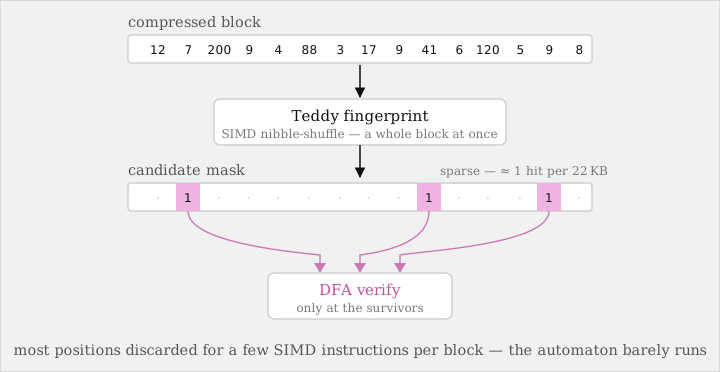
However, the prefilter is an additional preprocessing step, performed under the
assumption that the pattern is uncommon. When a pattern is so common that the
fingerprint flags nearly every position, the candidate mask stops filtering, and
we would pay for a full filtering pass in addition to the work that a plain scan
would already have finished. Our design is built for selective patterns, where
almost nothing matches, and the per-position cost stays small and uniform across
the scan. Due to this sensitivity, we implement a bail-out heuristic that
watches for the dense case; if necessary, our technique will fall back to plain
decompress-and-match rather than paying for a filter that cannot filter.
How fast is it?
The headline number comes from ClickBench Q20:
SELECT COUNT(*) FROM hits WHERE "URL" LIKE '%google%';This query is run over roughly a hundred million rows, using Vortex-backed
DuckDB and toggling pushdown. The table shows the median time at one thread
across the seven x86 generations we measured.
| Machine | With pushdown (ms) | Without pushdown (ms) | Speedup |
|---|---|---|---|
| AMD Rome | 1,068.6 | 3,721.3 | 3.48x |
| AMD Milan | 947.3 | 3,411.4 | 3.60x |
| AMD Genoa | 989.8 | 3,161.0 | 3.19x |
| AMD Turin | 600.9 | 2,095.1 | 3.49x |
| Intel Ice Lake | 1,679.5 | 4,293.4 | 2.56x |
| Intel Sapphire Rapids | 1,515.7 | 3,635.2 | 2.40x |
| Intel Emerald Rapids | 990.5 | 2,610.7 | 2.64x |
We then use the Milan and Sapphire Rapids machines to explore the impact of
thread-parallelism; add additional compute, and the decompress-first path begins
to catch up:
| Speedup at threads | 1 | 8 | 16 | 32 | 64 | full width |
|---|---|---|---|---|---|---|
| EPYC Milan (DDR4-3200, 56t) | 3.60x | 3.05x | 2.42x | 1.76x | — | 1.54x |
| Xeon Sapphire (DDR5, 88t) | 2.40x | 1.98x | 1.57x | 1.59x | 1.44x | 1.42x |
Decompression has a real per-byte compute cost, which is exactly what extra
cores enable; thus, the path that does more compute gains more from the
additional threads. On the widest box we tested, an 88-thread Sapphire Rapids
server, the win settles at 1.42x. Eventually, both paths read the same
compressed column from the same saturated memory bus; the only remaining
advantage is that the pushdown approach never moved those bytes in the first
place.
The full head-to-head comparison and many more measurements are in the companion post.
The same idea, twice
While we were building this, TU Munich's database group developed a mechanism
for the same goal, which was presented at
DaMoN 2026.
Instead of using a prefilter, they compile each pattern's automaton into machine
code, making each step cheap, whereas our prefiltering approach minimizes the
impact of our DFA. Having two independently developed implementations of the
same idea, with opposite failure modes, gives us a rare chance to explore the
LIKE pushdown design space. Using a wider set of experiments across the tested
machines, we explored the full space of
"Compile or Prefilter?"Code-space
LIKE pushdown ships today as part of the FSST encoding in
Vortex. The Teddy
prefilter and planner described here are on their way upstream from our research
branch. We build in the open; if you'd benefit from not having to decompress
your data before analyzing it, come find us on GitHub or reach out to us
directly.