Latest posts
Data Layouts: Where Bytes Find Their Forever Home
Feb 10, 2025 · by Robert Kruszewski · 8 min read
If you’re anything like me, you read every new message on
dev@apache.parquet.org with the hope of
learning something new about how to store and compress data. We often take file
formats like Apache Parquet for granted. However, these pieces of software are
built upon years of research and foundations laid out decades ago. The data
processing landscape has changed significantly since then. As we build Vortex, a
next-generation columnar file format, it’s worthwhile to revisit the history
that brought us here and question whether the assumptions of the past still hold
true.
The Evolution of Database Storage Models
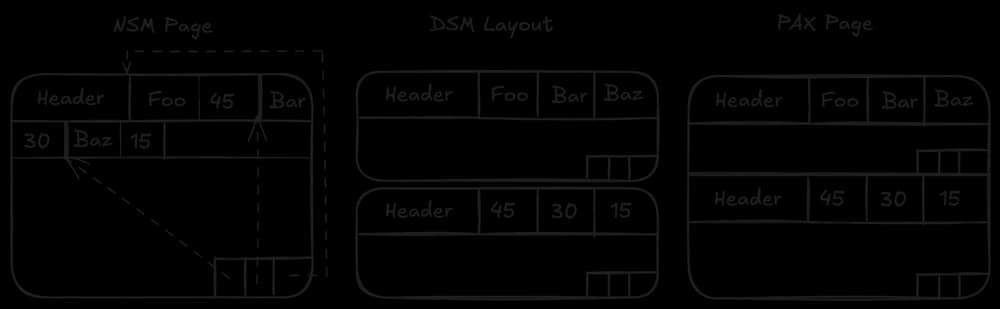
In the early days of databases, the predominant method was to store records
sequentially (row-wise), with record offsets stored at the end (NSM - N-ary
Storage Model). This row-wise model underpins many common file formats, such as
CSV and Apache Avro. The alternative approach of splitting data into individual
columns (DSM - Decomposition Storage Model) was rarely adopted, as the
limitations of storage and compute hardware at the time often led to
significantly poorer performance in practice. The first significant breakthrough
in performance came with PAX[1] (Partition Attributes Across), which blended the
strengths of both models by storing individual columns within row partitions.
Later research confirmed what we now consider commonplace: that columnar storage
with SIMD-accelerated execution on the DSM model could deliver substantially
better performance[2]. However, the story is more complex. Storage models were
heavily influenced by the technological constraints of their era. When NSM was
introduced, most data processing time was consumed by fetching data from
external storage. Since then, storage devices have come much closer to CPU
performance, and CPU development has shifted from boosting single-core speeds to
increasing core counts. Today, nearly all file formats designed for analytical
use cases—such as Apache Parquet and Apache ORC—follow the PAX design pattern.
The migration of data from traditional databases to cloud platforms, with their
virtually limitless storage capacity and significantly higher access latencies,
has forced us to revisit the evolution of database systems. The inherent
separation of storage and compute in cloud infrastructure allows us to
re-examine prior designs and potentially improve upon existing solutions.
Analytics is all about columnar access
Both Apache Parquet and Apache ORC are columnar file formats that utilize a
PAX-style layout. Parquet for example, calls their PAX page a "row group", each
of which contains values for all columns, one after another, for a single set of
rows.
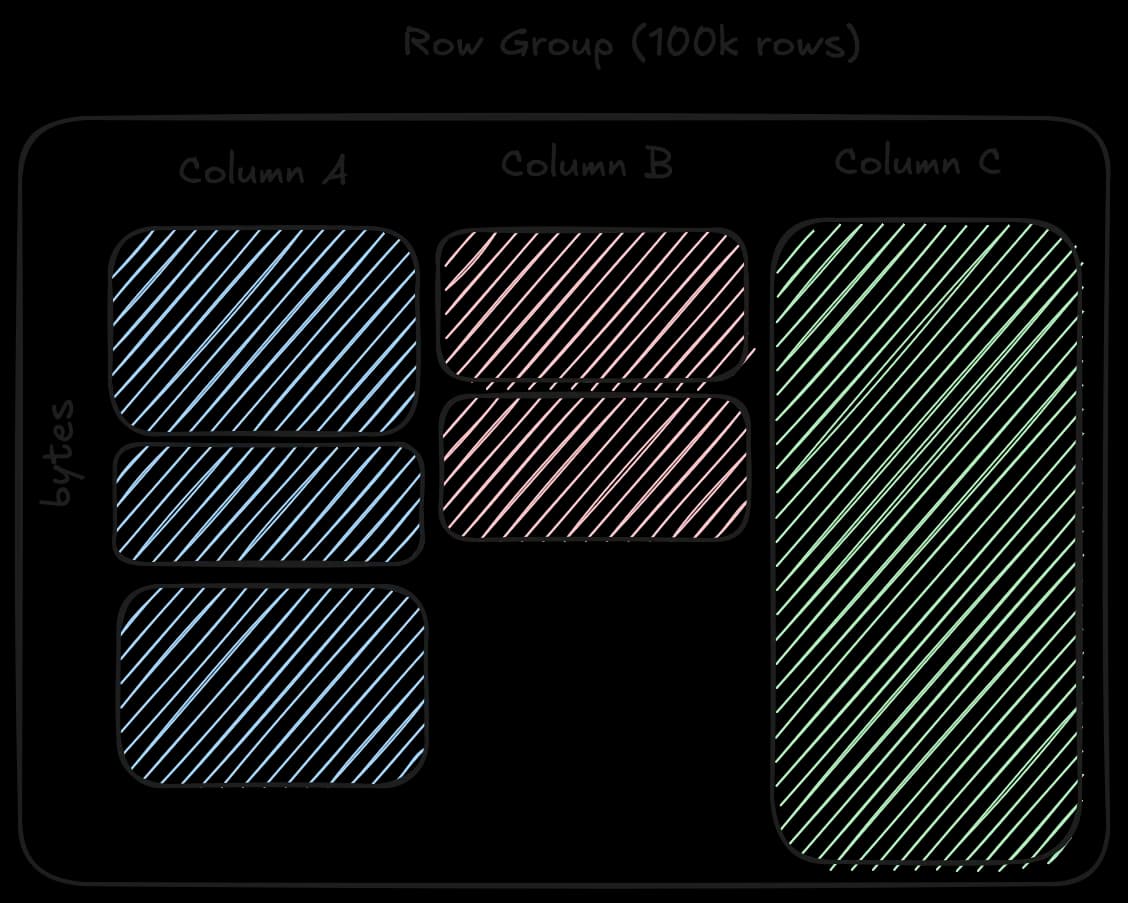
While row groups maintain reasonable locality for entire rows, they also allow
access to batches of values within specific columns. However, this reliance on
locality introduces significant challenges when dealing with a large number of
columns, or columns of varying widths.
The greater the disparity in size between columns, the more pronounced the
issues become, making it difficult to balance file organization and query
performance. This forces a trade-off: either include a reasonable number of
rows, which can result in excessively large row groups, or keep row group sizes
manageable, but with too few rows for efficient scanning.
Given these constraints, the design of Parquet (and any purely PAX-based format)
has no obviously good solution. Your storage system will live with tradeoffs,
leading to endless frustrations.
When fast record access matters
Analytical workloads have increasingly adopted PAX-like file formats to maximize
performance. However, this optimization hinges on a key assumption: that the
underlying data evolves slowly or remains largely static (which, incidentally,
is where Apache Iceberg gets its name from). PAX-like formats, due to their
structure, struggle with high-frequency writes. This creates a situation similar
to the skewed row groups problem—we end up with many small files that hurt write
performance. That’s the trade-off you accept when adopting a PAX-like solution.
After data arrives, you must perform compaction (combining smaller files into
fewer, larger files optimized for your system). The constraints of these file
formats are such that the simplest solution is to introduce another file format
that supports fast row access and appends. In this new format, you buffer
recent, un-compacted, writes and ensure readers know how to intersperse them
with existing records until compaction occurs. This technique is employed by
most systems built on top of Parquet, such as Apache Iceberg or Databricks Delta
Lake.
Beyond high-frequency writes, there’s an entire world of data storage systems
that still prefer row-based access. For instance, the TensorFlow project
introduced TFRecord to address the needs of machine learning workflows. TFRecord
is a row-oriented format, making it particularly suitable for training tasks
where accessing an entire row at once—such as data, labels, embeddings, and
metadata—is essential for updating model state or evaluating records.
TFRecord relies on Protocol Buffers (protobuf) as its definition language, a
format that has gained widespread popularity for data interchange. That said, if
you attempt to use TFRecord for analytical tasks, its performance would fall
short compared to specialized formats like Apache Parquet. As a result, if your
data is used beyond machine learning, you’re likely to maintain two separate
copies: one in TFRecord for training and another in Parquet for analytics.
A little bit of framing
In an era dominated by remote object stores, many traditional file formats are
no longer aligned with optimal access patterns. Numerous image formats, for
example, rely on a series of small initial reads to decode metadata, followed by
larger reads for raw data. However, these small reads become highly inefficient
when working with object stores, where such operations are costly both in terms
of price and performance. The performance cost is especially significant, as
object store connection latency can range between 20-100ms, which is much higher
than the ~100μs latency measured on a local SSD.
Cost-wise, you end up paying for every request made to the object store,
regardless of the amount of data transferred. Despite each request being
extremely cheap—around ~$0.40 per 1 million requests—this cost can quickly
become a dominating factor for large datasets that are frequently accessed.
While default file format readers can still function by treating object stores
as a filesystem facade, this approach is far from ideal for data retrieval. All
of these issues make it an obvious choice to redesign the format in which data
is stored, rather than optimizing every access pattern.
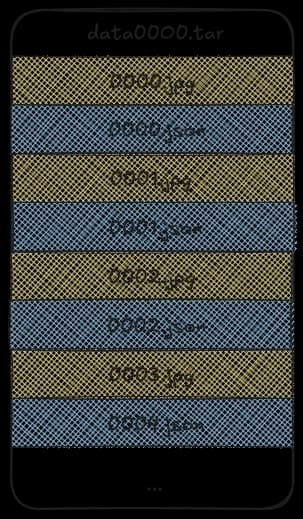
One such specialized format designed for large collections in object stores is
WebDataset. The idea behind it is to frame (wrap) images along with their
metadata into a tar archive. These archives can be randomly accessed if
necessary—for example, you can quickly jump to the offset for a given file. More
importantly, they can be efficiently streamed, as you retrieve one large file
with a single request, thereby leveraging the performance of sequential reads on
object stores.
Vortex
The variety of storage paradigms showcased by the file formats discussed in this
post highlights that no single data layout is universally superior. There is a
clear opportunity to offer analytics users an easier to manage format, while
machine learning users could benefit significantly from being able to use
analytics datasets directly in their projects without preprocessing or
maintaining duplicate copies.
Our key takeaway from these examples is that it’s unwise to enforce a rigid,
one-size-fits-all data layout. The differing access patterns between analytical
workloads, value retrieval, and machine learning demand flexibility in how data
is organized. Modern data formats are increasingly blending partial
normalization with PAX-like partitioning to strike a balance between locality,
compression efficiency, and sequential access performance.
Vortex design aims to leverage the historical lessons in file design while
allowing for experimentation with data layout. Recognizing the need for
customizable layouts, we created a self-describing format capable of serving
multiple use cases while offering consistent management and a user-friendly
interface for integration. Users can prioritize record access, storage
efficiency, or scan performance, depending on their needs. By simplifying
experimentation, Vortex aims to unlock research into performance improvements
that were previously out of reach due to the complexity of developing a file
format from the ground up. While the most common approaches for analytical
workflows involve splitting data column-wise or row-wise, Vortex allows for
entirely different chunking strategies tailored to specific columns or even
extracting shared data across multiple chunks or columns. This pluggable
behavior ensures that new strategies can be added in the future as we gain
deeper insights into access patterns.
At its core, Vortex layout tree defines how the data is divided and how to
reassemble it into a batch of data. The layout also specifies which parts can be
pruned or loaded lazily during file reads. Stay tuned for future posts, where
we’ll explore in detail how Vortex interprets these layouts and handles data
reading with pushdown optimizations.