Latest posts
Compile or Prefilter? Matching LIKE over Compressed Strings
Jul 14, 2026 · by Martin Prammer and Joe Isaacs · 10 min read
This is part two of a two-part series. This post assumes some familiarity with our technique for evaluatingLIKEpredicates over FSST-compressed strings, introduced in part one, Pattern Matching on Compressed Strings without Decompression, and will read best after the first.
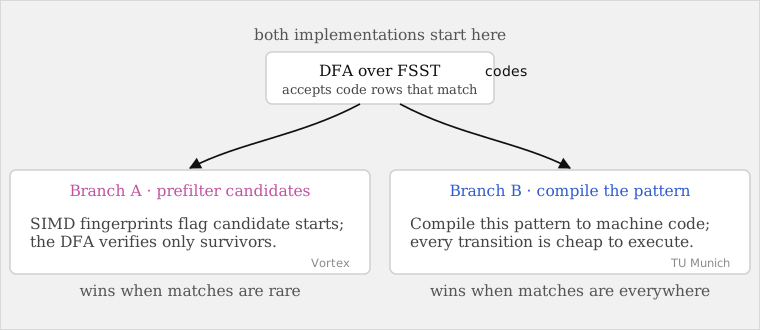
Two research groups independently explored the same question: Can we evaluate
SQL
LIKE against FSST symbol codes rather than decompressed text? These two
groups chose different execution strategies:
Vortex runs a
prefilter over the code stream, verifying the few surviving positions with an
automaton, while TU Munich (TUM), in work presented at
DaMoN 2026 and
TUMuchData, compiles
each pattern's automaton into machine code for faster execution.Thus, we have an unusually clean opportunity to map a design space. This post
explores this space through a large-scale sensitivity study that varies both
search predicates and underlying hardware. While the overall results align with
general trends in vectorized vs. compiled execution models, the per-predicate
results are more nuanced. As we show that both techniques are highly data- and
query-sensitive, we look toward a hybrid approach in the future, complementing
each with the other.
Our prefilter-based approach
Vortex starts from the same code-space DFA described in the first post. The
important choice is what happens at runtime. Stepping that DFA over every code
will generate a correct result, but the automaton step is not free; when
evaluating a selective pattern, almost every position it inspects never begins a
match. Thus, paying the full cost of the automaton everywhere to find a handful
of rows is untenable.
We place a SIMD literal prefilter in front of the verifier.
Teddy
extracts short literal substrings from the
LIKE pattern and builds a small
fingerprint table for them. As each compressed block arrives, SIMD shuffles test
multiple positions at once, producing a candidate mask for the DFA. Because the
DFA discards false positives, Teddy is designed to over-report only, enabling
the prefilter to optimize for speed.This shifts the steady-state work from “run the automaton everywhere” to
“fingerprint everything, then verify the few survivors.” The trade-off is
pattern-dependent: a selective literal makes the mask sparse and the verifier
cheap, whereas a dense literal turns the SIMD pass into overhead. Vortex's
planner uses a fingerprint-density estimate to choose between the SIMD-based
prefilter and direct DFA evaluation paths and can fall back to
decompress-and-match if necessary.
TU Munich's compiled automaton
The TUM implementation builds the automaton with an
Aho-Corasick-style
construction: a trie over the valid symbol sequences, plus failure links so that
a mismatch falls back to the longest still-viable state rather than restarting.
The escape byte forces a set of pseudo-end states because a trailing
255
cannot be resolved until the escaped byte it introduces arrives. Substring
patterns require two further construction phases, namely linking and splitting,
to stay deterministic across the partial-match failures that only substrings
produce.Their execution model is what makes their technique unique. TUM emits the
automaton's parsing code in three ways: an interpreted walker, C++ source
compiled by
clang++ into a shared library and loaded at runtime, and LLVM IR
that is JIT-compiled directly. The compiled variants bake the transition logic
for a specific pattern into machine code. This compilation step yields a fast
DFA, which, in turn, is less dependent on a prefiltering step.On top of that core, TUM applies several optimizations: caching sub-automata
that recur across patterns, assigning each state a level (its distance to
acceptance) so a scan can reject early when too little input remains, verifying
a pattern's unique prefix or suffix up front with integer comparisons, and
accelerating the state-0 self-loop (the step that skips bytes that cannot begin
a match) with SSE4.2 string instructions. The theoretical payoff is concrete:
checking a string of compressed length m drops from O(m) to O(1) for prefix
and suffix patterns, and to a worst case of O(min(L+1, m)) for substrings,
where L is the level of the automaton's start state, which is small for short
patterns.
Against two decompress-first baselines, namely a hybrid SIMD string search and
Vectorscan
(the open fork of Hyperscan), TUM reports 2.5–17x higher throughput on an Intel
i9-7900X. The LLVM variant is the fastest once the data is large enough to
justify the compilation cost, which can generally be amortized across many data
blocks.
Opposite failure modes
First principles indicate that the two designs fail in opposite ways. The
prefilter's weakness is the dense pattern, the case our bail-out already watches
for: when the fingerprint stops filtering, the SIMD pass becomes pure overhead.
This regime is exactly where a prefilter-free design, such as a tightly compiled
automaton, comes out ahead. However, when relying on a fast DFA, the weakness
lies in the mirror image. The compiled approach runs its automaton over every
code regardless of selectivity, and offsets that by driving the per-byte step as
cheaply as the compiler can manage. This is the right choice when the automaton
has to run over most of the data, but dead weight when a prefilter would have
discarded almost every position first.
That is the theory, and it is enough to sketch the curve we should expect:
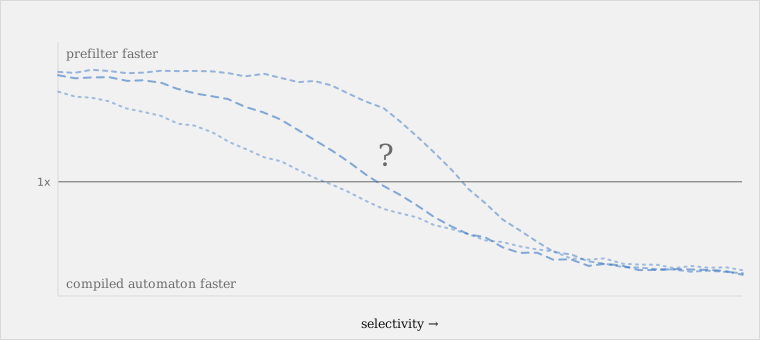
While first principles force the two ends, they say nothing about the shape of
the middle. We benchmark both pushdown implementations to explore this unknown
region.
Results
Everything below is part of a single experiment. The corpus is the ClickBench
URL column: ten million real URLs, FSST-compressed. We evaluate search
predicates that span selectivity from a handful of matching rows to essentially
all of them. We also group the predicates by length to explore the interaction
between predicate length and selectivity. We compare our prefilter with TUM's
compiled automaton across seven x86 generations, from AMD Rome through Turin to
Intel Ice Lake through Emerald Rapids. We plot 83 substring-shaped (%…%)
predicates from that sweep below.Results summary
The results substantiate our expectations, though they also contain surprising
elements. Before we get to specific numbers, here is an illustrative sketch of
what they show.
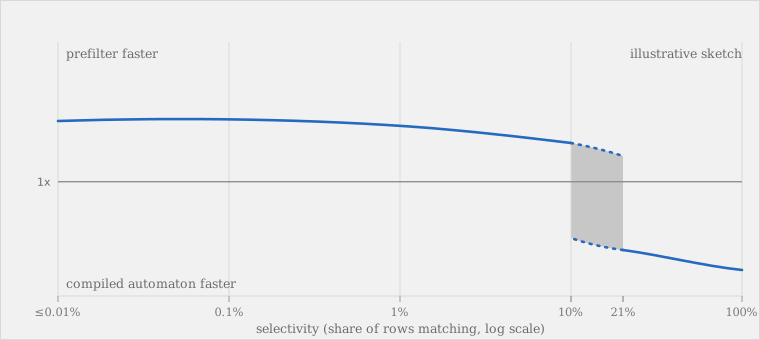
This sketch is intentionally shaped, highlighting the following behaviors:
- There are two regimes, split by selectivity, with one technique winning in each. Performance on each side is less affected by selectivity than one might expect.
- The performance of each regime is largely determined by the underlying machine.
- The point at which one regime (usually) wins out over the other lies between 10% and 21% selectivity. However, within this range, the search predicate itself plays a significant role in determining which regime a particular result belongs to. Thus, rather than a smooth transition from prefiltering-dominated to compiled-automata-dominated results, we find two overlapping sets of predicate-influenced behavior.
With these overarching results in mind, we explore our results in more detail.
Detailed results
Below is a table showing the results at the two ends of the sweep: a highly
selective predicate and a nearly unselective one. Each cell gives the named
winner's speedup over the other technique on that machine.
| Machine | %google% (prefilter wins by) | %http% (compile wins by) |
|---|---|---|
| AMD Rome | 2.40x | 9.30x |
| AMD Milan | 2.57x | 8.71x |
| AMD Genoa | 2.96x | 9.01x |
| AMD Turin | 4.57x | 6.71x |
| Intel Ice Lake | 1.74x | 7.36x |
| Intel Sapphire | 1.71x | 6.67x |
| Intel Emerald | 1.20x | 6.54x |
At the selective end, the prefilter is ahead on every machine, and by a margin
that is graded by vendor: on
%google%, which matches 646 rows out of ten
million, AMD chips run it 2.4x to 4.6x faster than the compiled automaton, while
Intel chips run 1.2x to 1.7x faster. At the dense end, the compiled automaton
wins everywhere, and by more: 6.5x to 9.3x on %http%, which matches all but a
few hundred rows. However, these numbers do not tell the full story.AMD
machine:
substring length:
All four AMD chips give the prefilter the selective end, and the margins are
ordered by launch year: on
%google%, Rome (2019) runs it 2.4x faster than the
compiled automaton; Milan (2021) 2.6x; Genoa (2022) 3.0x; and Turin (2024) 4.6x.
We observe that the prefilter's win grows monotonically across these four AMD
launches. At the same time, the JIT-compiled approach's relative speedup for
less selective search predicates shrinks as well.Intel
machine:
substring length:
While the overall shape of the Intel-based results is the same as AMD's, its
year trend runs the other way: Ice Lake (2021) gives the prefilter 1.7x on
%google%, while Emerald Rapids (2023), the newest Intel chip in the fleet,
thins that win to 1.2x. For less-selective queries, there does not seem to be a
pattern similar to what was observed in the AMD results.For ease of comparison, we present a single, combined results view below.
Both
machine:
substring length:
While the winner (almost) never changes across different hardware, the gap
itself shifts dramatically; compare Emerald Rapids, where the prefilter's
selective-end win thins to 1.2x, to Turin, where it stretches past 4.5x.
Further, these results underscore the importance of the exact search predicate.
First, we note the case of
%=%, a predicate with about 67.7% selectivity that
falls into neither regime. Its winner depends on the machine: the prefilter wins
on Turin, while the compiled automaton wins everywhere else. Likewise,
%yandex%, six bytes in 13.4% of rows, shows that the prefilter is faster on
every chip, contributing a unique point to the region ill-defined by
selectivity. Finally, %php%, three bytes at 13.6%, shows the compiled
automaton as the more effective approach on every chip. Note that php is built
from some of the most common byte patterns in a URL column, leading to the
fingerprint flagging candidates everywhere, filtering almost nothing; a failure
mode that the Vortex "bail-out" exists to handle.Deeper insights and future work
Setting the two implementations side by side taught us as much about our own
design as it did about the comparison.
Mostly Hyperscan
The most useful thing this exploration turned up is where our own branch sits in
the design space. Strip away the FSST framing, and the execution side of our
approach is
Hyperscan.
We did not set out to clone it; the candidate-then-verify shape is simply where
our design landed, and once the resemblance was obvious, we brought in
Hyperscan's actual prefilter rather than reinvent it. The Teddy pass is
Hyperscan's Teddy,
the multi-pattern path is its Fat Teddy, and the surrounding pipeline is the
literal-prefilter-plus-automaton architecture that Hyperscan popularized. Our
execution-side contribution is running that architecture over FSST codes rather
than raw bytes: a solid engineering result, and an integration rather than a new
matching technique.
TUM's branch sits in a quite different place. Their implementation contains no
literal prefilter at all, neither Teddy nor FDR, Hyperscan's two
literal-matching engines, so the single most Hyperscan-shaped component is
absent. They run the automaton over the entire compressed stream and rely on
code generation to make it fast, which Hyperscan does not do, since Hyperscan
compiles a pattern into a bytecode database that its fixed engines interpret
rather than into machine code. Their one point of contact with Hyperscan's
toolbox is the self-loop accelerator, which is shufti-flavored (find the next
interesting byte) rather than the full prefilter-and-verify pipeline. Thus,
their execution story is genuinely not "just Hyperscan," while ours, on the
execution side, mostly is. For those interested, we highly recommend their
DaMoN 2026
paper; it's worth the read.
Final thoughts
In this series, we explored two independent implementations of the same idea.
When set side by side, they clearly demonstrate the split behavior underpinning
the overall design space: the prefilter wins when the fingerprint discards most
positions, while the compiled automaton wins when there is less to discard. The
same map shows that the designs are complementary rather than competing. Our
implementation uses Hyperscan's prefilter, whereas TUM's approach relies solely
on a compiled engine.
One could consider a combination of both techniques a natural successor to both
implementations. The planner already computes the fingerprint-density estimate
that separates the two regimes, and that estimate can route each pattern to the
right engine: when density is low, run Teddy and verify the few survivors; when
it is high, bypass the prefilter and run a compiled automaton directly, exactly
where Teddy would have earned nothing. Placing a compiled automaton as the
verifier behind Teddy could also help the middle of the corridor, between 10 and
21 percent selectivity, though our measurements do not yet show whether that
extra complexity pays off. Neither codebase contains this system today, but
between them they hold the pieces.
We leave the exploration of this idea as future work.
The matcher described here is open source, and the Teddy prefilter and planner
are on their way upstream to
Vortex. Vortex has
repeatedly benefited from implementing ideas from research groups around the
world; we look forward to seeing where the future work of our research team and
TUM's database group will go.